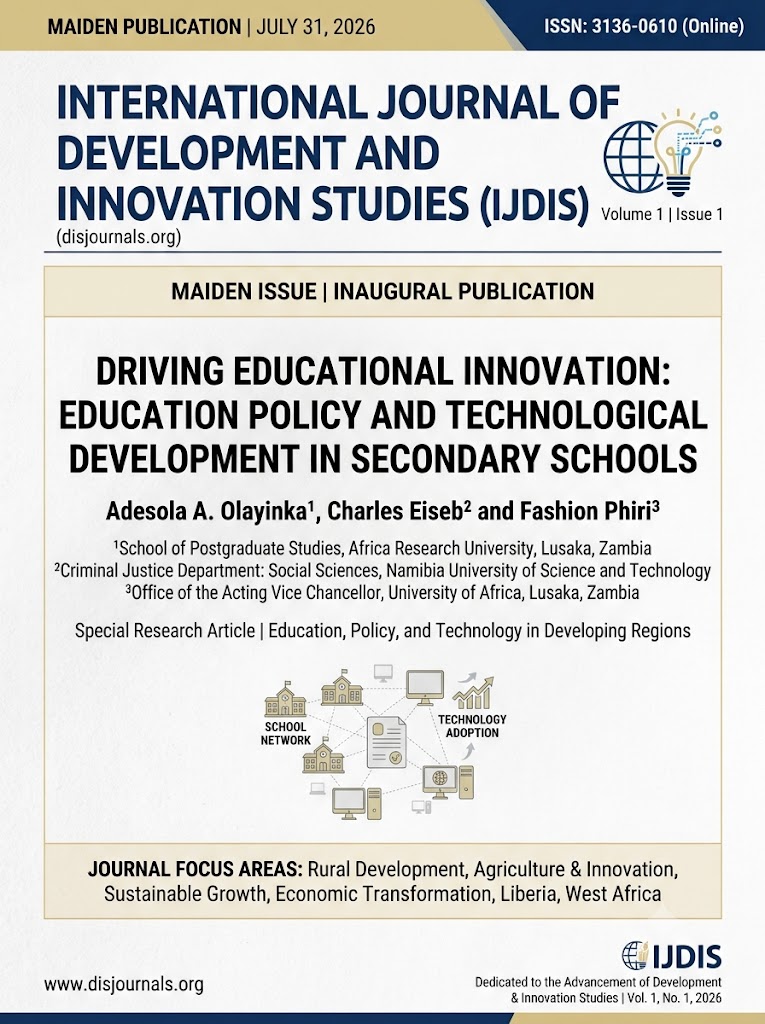
DRIVING EDUCATIONAL INNOVATION: EDUCATION POLICY AND TECHNOLOGICAL DEVELOPMENT IN SECONDARY SCHOOLS
DOI:
https://doi.org/10.67221/yv6et590Keywords:
- Academic performance, Education policy, Educational technology, Innovation, Student engagement, Technological developmentAbstract
This paper examines how education policy shapes technological development and the integration of digital tools in secondary schools. Using an embedded case study of urban secondary schools in Manzini Region, Kingdom of Eswatini, the study drew on surveys of 296 students, 48 teachers, and 25 administrative or support staff, complemented by 10 structured observation checklists. Policy implementation strength was operationalised through a policy rating index, while technological development was operationalised as school-level availability, functionality, and use of digital infrastructure and learning technologies. Correlation and linear regression analyses indicate that policy ratings significantly predict technological development (standardised β = 0.499, R² = 0.912, p < 0.001). Schools reporting clearer standards, resourcing, and implementation support also reported higher student engagement and improved academic performance trends. The findings underline that policy design is necessary but insufficient unless accompanied by financing, capacity development, and routine monitoring. Recommendations focus on sustained funding, teacher professional development, and accountability mechanisms to translate policy intent into measurable classroom-level technology use.
References
REFERENCES
[1] M. Fullan and M. Langworthy, A rich seam: how new pedagogies find deep learning (London: Pearson, 2014).
[2] W. R. Penuel and J. P. Spillane, Learning sciences and education policy: making connections to transform practice (Cambridge: Cambridge University Press, 2017).
[3] R. B. Kozma, The technological, economic, and social contexts for educational ICT policy, in Transforming education: the power of ICT policies (Paris: UNESCO, 2011) 9-24.
[4] N. Selwyn, Education and technology: key issues and debates (London: Bloomsbury Publishing, 2011).
[5] UNESCO, Artificial intelligence in education: challenges and opportunities for sustainable development (Paris: UNESCO, 2019).
[6] M. Warschauer, Learning in the cloud: technology and education in the digital age (Cambridge, MA: MIT Press, 2011).
[7] OECD, Innovating education and educating for innovation: the power of digital technologies and skills (Paris: OECD Publishing, 2016).
[8] W. R. Penuel, Creating and supporting the effective use of educational technology: an evidence-based approach (Cambridge, MA: Harvard Education Press, 2017).
[9] L. Darling-Hammond, M. E. Hyler, and M. Gardner, Effective teacher professional development (Palo Alto, CA: Learning Policy Institute, 2017).
[10] D. K. Cohen and H. C. Hill, Learning policy: when state education reform works (New Haven, CT: Yale University Press, 2018).
[11] A. Schleicher, World class: how to build a 21st-century school system (Paris: OECD Publishing, 2018).
[12] P. Sahlberg, Finnish lessons: what can the world learn from educational change in Finland (New York: Teachers College Press, 2011).
[13] J. L. Pressman and A. Wildavsky, Implementation: how great expectations in Washington are dashed in Oakland; or, why it’s amazing that federal programs work at all (Berkeley, CA: University of California Press, 1973).
[14] P. A. Sabatier and D. A. Mazmanian, The implementation of public policy: a framework of analysis, Policy Studies Journal, 8(4), 1980, 538-560.
[15] M. Hill and P. Hupe, Implementing public policy: an introduction to the study of operational governance, 2nd ed. (London: SAGE Publications, 2009).
[16] W. R. Penuel, C. E. Coburn, and L. P. Gallagher, Negotiating problems of practice in research-practice partnerships focused on educational improvement, Educational Policy, 27(1), 2013, 37-58.
[17] M. Fullan, The new meaning of educational change, 4th ed. (New York: Teachers College Press, 2007).
[18] G. Salmon, E-moderating: the key to teaching and learning online (London: Kogan Page, 2000).
Downloads
Published
Issue
Section
License
Copyright (c) 2026 Adesola Afolayan Olayinka, Fashion Phiri, Charles Eiseb (Author)

This work is licensed under a Creative Commons Attribution 4.0 International License.
Open Access Licensing Policy
International Journal of Development and Innovation Studies (IJDIS)
Published by DisJournals.org
IJDIS is an open-access journal committed to the free dissemination of scholarly knowledge.
All articles published in IJDIS are licensed under:
Creative Commons Attribution 4.0 International Licence (CC BY 4.0)
Under the CC BY 4.0 licence, readers are permitted to:
- share — copy and redistribute the material in any medium or format;
- adapt — remix, transform, and build upon the material for any purpose, including commercial purposes;
provided that appropriate credit is given to:
- the original author(s);
- the article title;
- IJDIS as the original publication source;
- the DOI link of the published article.
The licence requires users to provide appropriate attribution and indicate if changes were made.
The CC BY 4.0 licence supports maximum visibility, accessibility, and reuse of research outputs while protecting authors' intellectual contributions.
Full licence information is available at: