
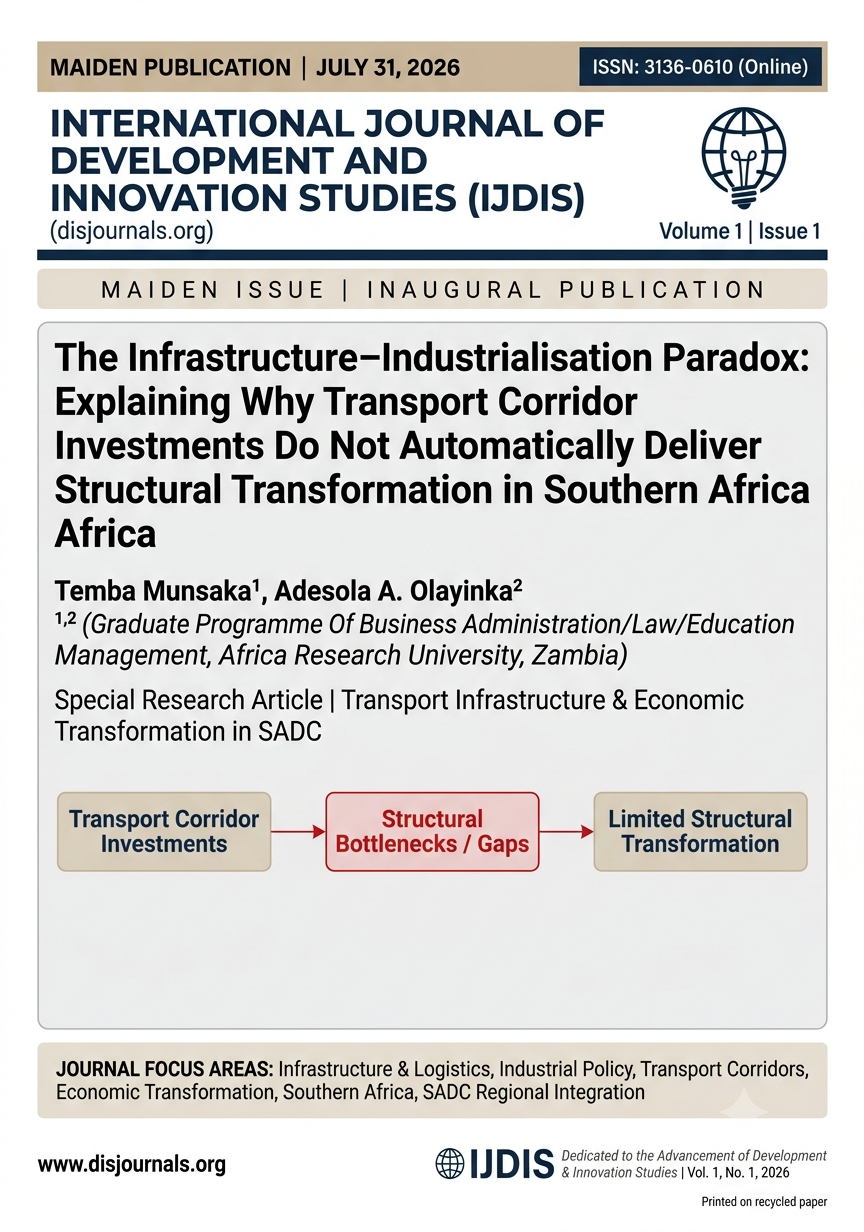
The Infrastructure–Industrialisation Paradox: Explaining Why Transport Corridor Investments Do Not Automatically Deliver Structural Transformation in Southern Africa
DOI:
https://doi.org/10.67221/6fka1w60Keywords:
: infrastructure development, industrialisation, regional integration, transport corridors,Abstract
: Infrastructure development has become central to economic transformation strategies in Sub-Saharan Africa, particularly within regional integration initiatives aimed at improving trade competitiveness and industrial development. Despite substantial investment in transport corridors, border modernisation and logistics infrastructure, evidence of their contribution to industrialisation remains mixed. This study examines the infrastructure-industrialisation paradox by investigating why improvements in transport efficiency do not consistently translate into structural transformation. Using a convergent mixed-methods design, the study draws on survey data from 300 respondents, twenty-five key informant interviews, six focus group discussions and secondary trade statistics from Zimbabwe and Zambia, focusing on the Kazungula Bridge and the upgraded Beitbridge Border Post. The findings indicate that infrastructure investment significantly improved border clearance times, regional connectivity and trade facilitation but did not generate sustained manufacturing growth, industrial diversification or broad-based enterprise development. Institutional weaknesses, fragmented industrial policy, limited access to productive finance, weak regional value chain integration and governance challenges emerged as the principal constraints. In response, the study proposes the Infrastructure Transformation Cascade Model (ITCM), a theoretically grounded and empirically informed framework demonstrating that infrastructure investment is a necessary but insufficient condition for structural transformation. The study concludes with policy recommendations for integrating transport infrastructure with industrial policy, enterprise development and institutional reform across Southern Africa.
References
Acemoglu, D., & Robinson, J. A. (2012). Why nations fail: The origins of power, prosperity and poverty. Crown Publishers.
African Development Bank. (2022). Kazungula Bridge project completion report. African Development Bank Group.
African Development Bank. (2024). African Economic Outlook 2024: Driving Africa's transformation. African Development Bank Group.
African Union. (2015). Agenda 2063: The Africa we want. African Union Commission.
Andreoni, A., & Chang, H. J. (2019). The political economy of industrial policy: Structural interdependencies, policy alignment and conflict management. Structural Change and Economic Dynamics, 48, 136–150. https://doi.org/10.1016/j.strueco.2018.10.007
Arvis, J. F., Raballand, G., & Marteau, J. F. (2018). The cost of being landlocked: Logistics costs and supply chain reliability. World Bank.
Braun, V., & Clarke, V. (2021). Thematic analysis: A practical guide. Sage.
Calderón, C., & Servén, L. (2014). Infrastructure, growth, and inequality: An overview. World Bank Policy Research Working Paper No. 7034. World Bank.
Creswell, J. W., & Creswell, J. D. (2018). Research design: Qualitative, quantitative, and mixed methods approaches (5th ed.). Sage.
Creswell, J. W., & Plano Clark, V. L. (2018). Designing and conducting mixed methods research (3rd ed.). Sage.
Donaldson, D. (2018). Railroads of the Raj: Estimating the impact of transportation infrastructure. American Economic Review, 108(4–5), 899–934. https://doi.org/10.1257/aer.20101199
Fetters, M. D., Curry, L. A., & Creswell, J. W. (2013). Achieving integration in mixed methods designs. Annals of Family Medicine, 11(2), 115–123. https://doi.org/10.1370/afm.1483
Field, A. (2021). Discovering statistics using IBM SPSS Statistics (6th ed.). Sage.
Frank, A. G. (1967). Capitalism and underdevelopment in Latin America. Monthly Review Press.
Hair, J. F., Black, W. C., Babin, B. J., & Anderson, R. E. (2022). Multivariate data analysis (9th ed.). Cengage.
Hirschman, A. O. (1958). The strategy of economic development. Yale University Press.
Lincoln, Y. S., & Guba, E. G. (1985). Naturalistic inquiry. Sage.
Lin, J. Y. (2012). New structural economics: A framework for rethinking development and policy. World Bank.
OECD. (2024). Africa's development dynamics 2024: Skills, jobs and productivity. Organisation for Economic Co-operation and Development.
Pallant, J. (2020). SPSS survival manual (7th ed.). McGraw-Hill.
Patton, M. Q. (2015). Qualitative research and evaluation methods (4th ed.). Sage.
Rodrik, D. (2016). Premature deindustrialization. Journal of Economic Growth, 21(1), 1–33. https://doi.org/10.1007/s10887-015-9122-3
Rosenstein-Rodan, P. N. (1943). Problems of industrialisation of Eastern and South-Eastern Europe. Economic Journal, 53(210/211), 202–211.
Rostow, W. W. (1960). The stages of economic growth: A non-communist manifesto. Cambridge University Press.
SADC. (2020). Regional Indicative Strategic Development Plan (RISDP) 2020–2030. Southern African Development Community Secretariat.
SADC. (2022). Regional infrastructure development master plan: Progress report. Southern African Development Community Secretariat.
Tashakkori, A., & Teddlie, C. (2021). Handbook of mixed methods research (2nd ed.). Sage.
UNCTAD. (2024). Review of Maritime Transport 2024. United Nations Conference on Trade and Development.
UNECA. (2023). Economic Report on Africa 2023: Building Africa's resilience through regional integration. United Nations Economic Commission for Africa.
UNIDO. (2024). Industrial Development Report 2024: Turning challenges into sustainable industrial development. United Nations Industrial Development Organization.
World Bank. (2023). Africa's Pulse (Vol. 28). World Bank.
Published
Issue
Section
License
Copyright (c) 2026 Temba Munsaka, Adesola A Olayinka (Author)

This work is licensed under a Creative Commons Attribution 4.0 International License.
Open Access Licensing Policy
International Journal of Development and Innovation Studies (IJDIS)
Published by DisJournals.org
IJDIS is an open-access journal committed to the free dissemination of scholarly knowledge.
All articles published in IJDIS are licensed under:
Creative Commons Attribution 4.0 International Licence (CC BY 4.0)
Under the CC BY 4.0 licence, readers are permitted to:
- share — copy and redistribute the material in any medium or format;
- adapt — remix, transform, and build upon the material for any purpose, including commercial purposes;
provided that appropriate credit is given to:
- the original author(s);
- the article title;
- IJDIS as the original publication source;
- the DOI link of the published article.
The licence requires users to provide appropriate attribution and indicate if changes were made.
The CC BY 4.0 licence supports maximum visibility, accessibility, and reuse of research outputs while protecting authors' intellectual contributions.
Full licence information is available at: