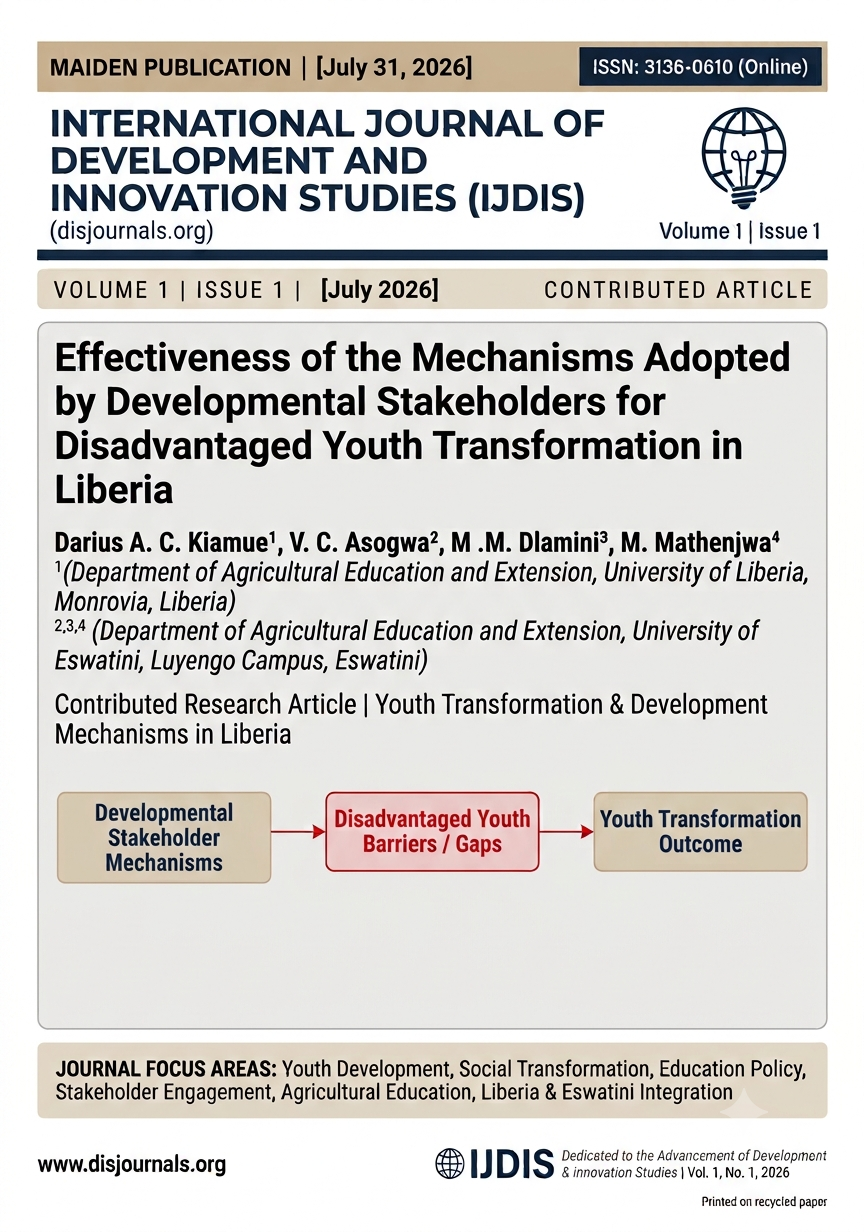
The Effectiveness of the Mechanisms Adopted by Developmental Stakeholders for Disadvantaged Youth Transformation in Liberia
DOI:
https://doi.org/10.67221/n20x2p82Keywords:
agricultural entrepreneurship, disadvantaged youth, developmental stakeholders, empowerment mechanisms, youth transformationAbstract
ABSTRACT: Liberia's post-conflict youth face unemployment, educational deficits, and exclusion despite government, NGO, and faith-based empowerment mechanisms with unexamined effectiveness. This study examined the perceived effectiveness of mechanisms implemented by development stakeholders for youth transformation through agricultural entrepreneurship. A quantitative cross-sectional survey of 391 disadvantaged youth across Liberia’s 15 counties employed stratified proportional and simple random sampling. Mechanisms were rated on six-point effectiveness scale and analysed using descriptive statistics, Pearson correlation, multiple regression, one-way ANOVA, post-hoc tests, and exploratory factor analysis. NGO mechanisms recorded the highest per-item mean (1.893, SD = 0.240), narrowly above government (1.769, SD = 0.348) and substantially above faith-based (1.464, SD = 0.276), with ANOVA confirming significant inter-group differences [F(2, 1170) = 171.62, p < .001]. Regression shows that government mechanism (β = −0.279, p < .001) and market access innovation (β = −0.894, p < .001) were significantly negatively associated with youth transformation index, whereas alternative financing was significantly positively associated with it (β = 0.135, p < .05; R² = 0.106). Rural youth reported higher transformation scores than peri-urban peers [F(2, 388) = 4.548, p = .011]. Findings revealed systemic gap between existing mechanisms and youth needs, highlighting integrated finance- and market-linked agricultural entrepreneurship for youth transformation.
KEYWORDS: agricultural entrepreneurship, disadvantaged youth, developmental stakeholders, empowerment mechanisms, youth transformation
References
Andersson, M. A., & Harnois, C. E. (2020). Higher exposure, lower vulnerability? The curious case of education, gender discrimination, and Women's health. Social science & medicine, 246, 112780.
Ani, N. C., Ogunade, F., & Kamma, J. (2025). Youth gangs in Liberia: motives, structure and illicit economies. Research Paper, (49).
Awazi, N. P. (2026). West Africa: Strengthening Livelihoods for Resilience in Fragile Contexts. In The Nexus Between Livelihood Capital and Resilience in Africa: Regional Perspectives and Pathways (pp. 125–166). Cham: Springer Nature Switzerland.
Bah, M. W., & Ulibarri, N. (2026). Climate Risk, Governance, and Institutional Adaptation Challenges in Liberia. Case Studies in the Environment, 10(1), 2860812. https://doi.org/10.1525/cse.2025.2860812
Bauer, A., Garman, E., McDaid, D., Avendano, M., Hessel, P., Díaz, Y., ... & Evans-Lacko, S. (2021). Integrating youth mental health into cash transfer programmes in response to the COVID-19 crisis in low- and middle-income countries. The Lancet Psychiatry, 8(4), 340–346.
Baxter, M., Novy-Marx, M., & D'Angelo, S. (2022). Improving pathways for girls and disadvantaged youth through secondary education and into work. Development Policy Review, 40, e12651. https://doi.org/10.1111/dpr.12651
Bhadra, S. (2023). Marginalized youths and inequalities: the global scenario and way forward. In Handbook of youth development: Policies and perspectives from India and beyond (pp. 387-411). Singapore: Springer Nature Singapore.
Bloh, O. (2025). Barriers to education, work, and security persist for Liberian women despite support for equal rights.
Cairney, P. (2025). Policymaking integration, policy coherence, and whole-of-government approaches: a qualitative systematic review of advice for policymakers. Open Research Europe, 5, 75. doi: 10.12688/openreseurope.19864.1
Chakrabarti, S. (2023). Factors influencing rural non-farm employment and quality of employment. Icfai University Jharkhand.
Corio, M. (2022). Addressing the future of food & youth in sub-Saharan Africa: the case for government-led, school-based agricultural education. AgriCorps White Paper.
Country, N. (2017). Liberia. North Asian International Research Journal of Multifisiplinary, 3(1), 3-23.
Dean, L., Tolhurst, R., Nallo, G., Kollie, K., Bettee, A., & Theobald, S. (2023). A health-systems journey towards more people-centred care: lessons from neglected tropical disease programme integration in Liberia. Health Research Policy and Systems, 21(1), 29.
Dearing, J. W., & Cox, J. G. (2018). Diffusion of innovations theory, principles, and practice. Health Affairs, 37(2), 183-190. https://doi.org/10.1377/hlthaff.2017.1104
DeJaeghere, J. (2021). Reframing life skills: From an individualistic to a relational transformative approach. In Life Skills Education for Youth: Critical Perspectives (pp. 73–90). Cham: Springer.
Dolo, E. G. V. (2018). The PASL Model: a New Agricultural Development Model for Liberia.
Doussard, M., & Yenigun, O. (2024). From capital to capabilities: human development theory and new directions in economic development. Journal of Planning Education and Research, 44(3), 1542-1555.
Dukuly, F. S., & Huang, K. (2020). The study on the impact of Liberia’s exports and imports on its economic growth. Open Journal of Business and Management, 8(6), 2649-2670. https://doi.org/10.4236/ojbm.2020.86164
Dukuly, S. S. (2014). Country Report on Policies and Mechanisms for Integration into the Workforce and Job Creation: Republic of Liberia. ILO.
Fortune, F. (2021). Working Joblessness: Young People Deploying 21st Century Skills in Post-Conflict Liberia and Sierra Leone. Doctoral dissertation, Wilfrid Laurier University.
Fox, L., & Kaul, U. (2018). The evidence is in: How should youth employment programs in low-income countries be designed? World Bank Policy Research Working Paper, (8500).
Gbatu, A. S. (2022). Access to Finance: Determinants and Limitations to the Demand Side of Finance for Liberia’s Rural Market. Texila International Journal of Academic Research, 9(4), 146-159. DOI: 10.21522/TIJAR.2014.09.04.Art014
Georgieva, M. K., & Georgieva, D. M. (2025). Republic of Liberia Ministry of Finance & Development Planning: Governance Assessment. Working Paper.
Gruijters, S., Fleuren, B., & Peters, G. J. (2021). Crossing the seven Cs of internal consistency: Assessing the reliability of formative instruments.
Innis, P. G., & van Assche, K. (2023). Permanent incompleteness: Slow electricity roll-out, infrastructure practices and strategy formation in Monrovia, Liberia. Energy Research & Social Science, 99, 103056. https://doi.org/10.1016/j.erss.2023.103056
International Labour Organization. (2025). World Employment and Social Outlook: Trends for Youth 2025. ILO.
Jahani, R., & Parayandeh, M. Y. (2024). The role of faith-based organizations in social service provision. Interdisciplinary Studies in Society, Law, and Politics, 3(3), 12-19. https://doi.org/10.61838/kman.isslp.3.3.3
Jappah, J. V., & Smith, D. T. (2022). Teacher training as a key component of educational investment and human development in postconflict Liberia. Africa Today, 68(3), 45–63.
Jocelyne, S., & Kariuki, M. (2020). Human capital, employee empowerment, and organizational performance. International Academic Journal of Human Resource and Business Administration, 3(9), 319-332. http://iajournals.org/articles/iajhrba_v3_i9_319_332.pdf
Jones, J. L. B. (2021). Performance as public work: Youth as civic actors for policy and practice in Liberia (Doctoral dissertation, University of Pennsylvania).
Jockers, D., Ngafuan, R., Baernighausen, T., Kessley, A., White, E. E., Kenny, A., ... & Hirschhorn, L. R. (2022). Implementation of the Liberia National Community Health Assistant (NCHA) Program and Under-five Mortality: A study protocol. medRxiv, 2022-07.
Kaluarachchi, K. A. D. P. (2025). Philosophical Approaches to Qualitative Research (Positivism, Phenomenological Approach & Critical Social Sciences). Sri Lanka Journal of Social Work, 8(2
Kelly, L. (2020). Evidence on resilience approaches in fragile and conflict-affected states and protracted crises.
Kimou, A. J. C., & Barry, I. A. (2022). Youth Employability and Peace-Building in Post-Conflict Côte d'Ivoire: Evidence from a Randomized Controlled Trial. Working Paper. URI: https://publication.aercafricalibrary.org/handle/123456789/3348
Kluve, J., Puerto, S., Robalino, D., Romero, J. M., Rother, F., Stöterau, J., ... & Witte, M. (2019). Do youth employment programs improve labor market outcomes? A quantitative review. World Development, 114, 237–253. https://doi.org/10.1016/j.worlddev.2018.10.004
Lahai, J. I., & Koomson, I. (2020). State fragility and resilience in sub-Saharan Africa: Indicators and interventions. Routledge.
Lakemann, T. (2025). Small-scale entrepreneurship and informal employment: evidence from sub-Saharan Africa.
Learwellie, B. A. (2024). Analyzing Youth Empowerment Programs and Their Impact in Urban and Rural Liberia. Working Paper.
Lingard, B., Sellar, S., & Savage, G. C. (2017). Re-articulating social justice as equity in schooling policy: The effects of testing and data infrastructures. In Neoliberalism and education (pp. 78-98). Routledge.
Lindberg, E. (2014). Youth and the labour market in Liberia: On history, state structures and spheres of informalities. Nordiska Afrikainstitutet.
LISGIS. (2009). 2008 National Population and Housing Census: Final Results. Monrovia: Liberia Institute of Statistics and Geo-Information Services.
Louis, E., Mauto, T., Dodd, M. L., Heidenrich, T., Dolo, P., & Urey, E. (2020). Using a gender-responsive land rights framework to assess youth land rights in rural Liberia. Land, 9(8), 247. https://doi.org/10.3390/land9080247
Levey, E. J., Carney, J. R., Dominguez, S., Wang, E. K. S., Boxill, R., Henderson, D. C., & Harris, B. L. (2013). Assessment of the needs of vulnerable youth populations in post-conflict Liberia: original. African journal of psychiatry, 16(5), 349-355.
Madadizadeh, F., & Bahariniya, S. (2023). Tutorial on how to calculate content validity of scales in medical research. Perioperative Care and Operating Room Management, 31, 100315.
Coupaud, M., Grolleau, G., & Mzoughi, N. (2026). Leveraging an Unhappiness Lens for Smarter Policies. Policy Studies Journal, e70123.
Mayengo, N., Namusoke, J., Kibedi, H., & Amone-P'Olak, K. (2025). Education-to-Work Transition Among the Youth in Post-Conflict Settings. Social Sciences, 14(7), 400. https://doi.org/10.3390/socsci14070400
McMahon, J., McInnes, E., Wan, C. S., Straiton, N., Lam, L., Rodgers, J., ... & Fulbrook, P. (2026). Effectiveness of organisational strategies for pressure injury prevention and treatment in acute hospital settings: a systematic review. Journal of Advanced Nursing, 82(3), 2004-2021. https://doi.org/10.1111/jan.17090
Mohajan, H. K. (2020). Quantitative research: A successful investigation in natural and social sciences. Journal of economic development, environment and people, 9(4), 50-79.
Mvukiyehe, E., & Samii, C. (2021). Peacekeeping and development in fragile states: Micro-level evidence from Liberia. Journal of Peace Research, 58(3), 368–383. https://doi.org/10.1177/0022343320912813
Ochube, G. A. (2023). A Study of the Causes And Effects of Armed Conflict on Children's Educational Development In Benue State, Nigeria (2018.
Oliver, A. L., & Rittblat, R. (2025). Human (Face-to-Face) and Digital Innovation Platforms and Their Role in Innovation and Sustainability. Platforms, 3(3), 12. https://doi.org/10.3390/platforms3030012
Orozco Garcia, T., & Ferguson, N. T. (2025). Jobs and livelihoods programming for economic and social stability in fragile places: Evidence from Tunisia and Somalia (No. 93/25). UNU-WIDER Working Paper. doi:10.35188/UNU-WIDER/2025/652-0
Rao, S. (2025). Youth Unemployment and Social Stability: A Cross-National Review. Stout in Humanities and Social Sciences, 1(1), 12-20. DOI: https://doi.org/10.61424/34hk0h64
Rogers, E. M. (2003). Diffusion of Innovations (5th ed.). Free Press.
Rogers, K., Le Kirkegaard, R., Wamoyi, J., Grooms, K., Essajee, S., & Palermo, T. (2024). Systematic review of cash plus or bundled interventions targeting adolescents in Africa to reduce HIV risk. BMC Public Health, 24(1), 239.
Russo, D., & Stol, K. J. (2021). PLS-SEM for software engineering research: An introduction and survey. ACM Computing Surveys (CSUR), 54(4), 1-38. https://doi.org/10.1145/34475
Serwaah, P. (2025). The Role of External Actors in Shaping Civil Society and Human Rights Protection in Post-Conflict Africa. International Journal of Research and Innovation in Social Science, 9(10). DOI: 10.47772/IJRISS.2025.910000438
Shahbaz, M. (2025). The Impact of Financial and Non-Financial Rewards on Employee Turnover in the Telecom Industry of Pakistan: The Moderating Role of Training and Development (Doctoral dissertation, University of Wales Trinity Saint David (United Kingdom).
Šíma, A. (2025). A Systematic Review of Youth Employment Interventions in Fragile, Conflict-Affected, and Violent Settings: Linking Context, Mechanisms, and Outcomes.
Smith-Omomo, J. (2018). African indigenous financial institutions: the case of Congo and Liberia. Springer.
Stites, E., & Bushby, K. (2017). Livelihood strategies and interventions in fragile and conflict-affected areas. Feinstein International Center.
Tarpeh, S., & Hustedde, R. (2021). How faith-based organizations perceive their role in community development: An exploratory study. Community Development, 52(1), 61-76. https://doi.org/10.1080/15575330.2020.1831565
Udenka, A. F. (2023). Evaluation of Employability Skills Programme for Youth Employment Initiative in Liberia. Doctoral dissertation, Unicaf University.
Vonhm, M. E. (2022). “A Family Tree Can Bend, but It Can Never Be Broken”: Teachers Affected by Civil War Understanding of Social Cohesion in Post-Conflict Liberia (Doctoral dissertation, George Mason University).
Wesseh, C. W. (2025). Rural Revitalization of Liberia: Challenges and Opportunities under the Government's ARREST Agenda. SSRN Working Paper 5127096. http://dx.doi.org/10.2139/ssrn.5127096
Witinok-Huber, R., Radil, S., Sarathchandra, D., & Nyaplue-Daywhea, C. (2021). Gender, place, and agricultural extension: a mixed-methods approach to understand farmer needs in Liberia. The Journal of Agricultural Education and Extension, 27(4), 553–572. https://doi.org/10.1080/1389224X.2021.1880453
Published
Issue
Section
License
Copyright (c) 2026 Darius A. C. Kiamue , Vincent C. Asogwa, Mbuyazwe M. Dlamini, Mpendulo Mathenjwa (Author)

This work is licensed under a Creative Commons Attribution 4.0 International License.
Open Access Licensing Policy
International Journal of Development and Innovation Studies (IJDIS)
Published by DisJournals.org
IJDIS is an open-access journal committed to the free dissemination of scholarly knowledge.
All articles published in IJDIS are licensed under:
Creative Commons Attribution 4.0 International Licence (CC BY 4.0)
Under the CC BY 4.0 licence, readers are permitted to:
- share — copy and redistribute the material in any medium or format;
- adapt — remix, transform, and build upon the material for any purpose, including commercial purposes;
provided that appropriate credit is given to:
- the original author(s);
- the article title;
- IJDIS as the original publication source;
- the DOI link of the published article.
The licence requires users to provide appropriate attribution and indicate if changes were made.
The CC BY 4.0 licence supports maximum visibility, accessibility, and reuse of research outputs while protecting authors' intellectual contributions.
Full licence information is available at: