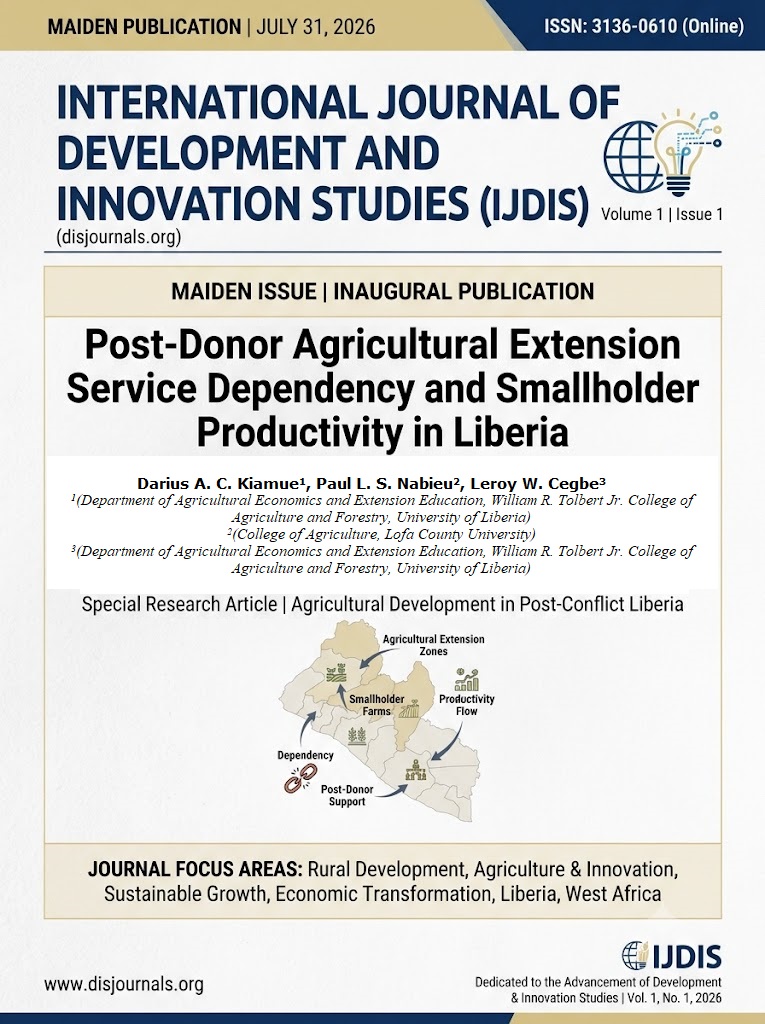
The Post-Donor Agricultural Extension Service Dependency and Smallholder Productivity in Liberia
DOI:
https://doi.org/10.67221/znc58m80Keywords:
agricultural extension, donor dependency, smallholder productivity, Liberia, institutional support, post-conflict agriculture, extension sustainabilityAbstract
Agricultural extension is critical to post-conflict recovery in Liberia, yet sustained donor withdrawal has exposed significant dependency challenges to productivity. This study examined the level of post-donor agricultural extension service dependency, its effect on smallholder productivity, and the moderating role of institutional support capacity. A quantitative explanatory cross-sectional survey design was selected. This design enables systematic hypothesis testing and identification of associations within a representative sample at a specific point in time. Data were collected from 395 randomly selected smallholder farmers across Bong, Lofa, Nimba, Grand Bassa, and Margibi counties. Data were collected using a structured questionnaire measuring dependency, productivity, institutional support, and transition barriers. The instrument was validated by five agricultural extension experts, pretested among 40 respondents, and demonstrated acceptable reliability. Data were analysed using descriptive statistics, Pearson correlation, multiple regression, and moderation analysis. Findings showed a high overall dependency level (mean = 3.11), with behavioural dependency highest (mean = 3.38). Technology adoption continuity, defined as the sustained utilisation of donor-introduced practices beyond project closure, remained low (38.2%), indicating weak post-project sustainability. Dependency significantly and negatively affected productivity (β = −0.43, p < 0.001), explaining 37% of productivity variation and confirming H₁. Institutional support capacity significantly moderated this relationship (β = 0.19, p < 0.001), increasing explanatory power to 51%, thus supporting H₂. Major barriers included stipend expectations (mean = 3.52) and weak government extension coverage (mean = 3.34). The study concludes that strengthening institutional support systems is essential for sustaining agricultural productivity and extension system resilience in Liberia.
References
Aerni, P., & Zou, W. (2022). Stakeholder Surveys in Selected African Countries on the Perception of Initiatives to Promote Capacity Development (CD) for Agricultural Innovation. CCRS Working Paper 1/2022. Available online at: https://www. ccrs. ch/en/research/publications/workingpapers.
Ahn, J., Briers, G., Kibriya, S., & Price, E. (2020). Case studies of female-headed farms and households in Liberia: a comparative analysis of Grand Bassa, Lofa, and Nimba counties. The Journal of Agricultural Education and Extension, 26(1), 19-35. https://doi.org/10.1080/1389224X.2019.1693407
Akobeng, E. (2020). Harnessing foreign aid for the poor: role of institutional democracy. Journal of Economic Studies, 47(7), 1689-1710. https://doi.org/10.1108/JES-05-2019-0225
Allen Jr, A. D., & Diallo, K. (2025). Agricultural Dynamics in Liberia: Current Issues and Solutions. International Journal of Research and Innovation in Social Science (IJRISS), 9(10). DOI: 10.47772/IJRISS.2025.910000604
Amevor, E. B. (2022). Gender-power relations in international development discourse and practice: The case of USAID in post-Ebola Liberia (Doctoral dissertation, University of Oregon).
Anang, B. T., Amesimeku, J., & Fearon, J. (2021). Drivers of adoption of crop protection and soil fertility management practices among smallholder soybean farmers in the Tolon district of Ghana. Heliyon, 7(5).
Apeh, C. C., Chiemela, S. N., Apeh, A. C., Okere, R. A., Ukwuaba, S. I., & Onyekuru, A. N. (2024). Analysis of the Adoption of Soil Nutrient Management Practices: A Case of Rice Farmers in Liberia. Land Degradation & Development, 35(18), 5549-5558. https://doi.org/10.1002/ldr.5314
Azizah, S., & Aprylasari, D. (2025). Farmer: The Decision Maker. Yayasan Drestanta Pelita Indonesia.
Babchishin, K. M., & Helmus, L. M. (2016). The influence of base rates on correlations: An evaluation of proposed alternative effect sizes with real-world data. Behaviour research methods, 48(3), 1021-1031.
Blum, J. R., Ferreiro-Rodríguez, M., & Srivastava, V. (2018). Paths between peace and public service: a comparative analysis of public service reform trajectories in postconflict countries. World Bank Publications.
Buehren, N., Goldstein, M., Molina, E., & Vaillant, J. (2019). The impact of strengthening agricultural extension services on women farmers: Evidence from Ethiopia. Agricultural Economics, 50(4), 407-419. DOI:https://doi.org/10.1111/agec.12499
Cummings, C. L. (2018). Cross-sectional design. The SAGE Encyclopedia of Communication Research Methods. Thousand Oaks: SAGE Publications Inc. Retrieved. DOI: http://dx.doi.org/10.4135/9781483381411.n118
Dangi, J. C., & Yadav, S. K. (2025). Strengthening Rural Communities with Participatory Extension Models. New Frontiers in Agricultural Extension Strategies, 107.
Danso-Abbeam, G., Ehiakpor, D. S., & Aidoo, R. (2018). Agricultural extension and its effects on farm productivity and income: insight from Northern Ghana. Agriculture & Food Security, 7(1), 74.
Davis, K. (2020). Application of the Best-Fit Framework. Agricultural extension: Global status and performance in selected countries, 53.
Dolo, E. G. V. (2018). The PASL Model: a New Agricultural Development Model for Liberia.
Geza, W., Ngidi, M., Ojo, T., Adetoro, A. A., Slotow, R., & Mabhaudhi, T. (2021). Youth participation in agriculture: A scoping review. Sustainability, 13(16), 9120. https://doi.org/10.3390/su13169120
Harris, J. (2023). Exploring donor-driven skills development as a channel of continued aid dependency. Third World Quarterly, 44(6), 1249-1268. https://doi.org/10.1080/01436597.2023.2178889
Ifeanyi-obi, C. C., Henri-Ukoha, A., & Familusi, L. C. (2024). Analysis of Climate Change Knowledge and Capacity Needs of Rural Women Farmers in Southern Nigeria. South African Journal of Agricultural Extension, 52(3), 132-157. https://doi.org/10.17159/2413-3221/2024/v52n3a15659
Kamara, L. I. (2019). The use of agricultural innovation systems approaches in Sierra Leone: exploring perceptions on innovations in rice production, research and extension (Doctoral dissertation, University of Reading).
Kauppi, K. (2022). Institutional theory. In Handbook of theories for purchasing, supply chain and management research (pp. 320-334). Edward Elgar Publishing. DOI: https://doi.org/10.4337/9781839104503.00025
Kimaro, J. R. (2018). Analysis of the Monitoring and Evaluation System: A Case Study of the Tanzanian Local Government (Doctoral dissertation, University of Pretoria (South Africa).
Lawal, K. F. (2023). Perceived effectiveness of public extension services among maize-based smallholder farmers in Kwara State, Nigeria (Master's thesis, Kwara State University (Nigeria).
Leeuwis, C., Boogaard, B. K., & Atta-Krah, K. (2021). How food systems change (or not): governance implications for system transformation processes. Food security, 13(4), 761. doi: 10.1007/s12571-021-01178-4
Lopes, C. (2024). The self-deception trap: Exploring the economic dimensions of charity dependency within Africa-Europe relations (p. 252). Springer Nature.
Mapiye, O., Makombe, G., Molotsi, A., Dzama, K., & Mapiye, C. (2021). Towards a revolutionised agricultural extension system for the sustainability of smallholder livestock production in developing countries: The potential role of ICTs. Sustainability, 13(11), 5868. https://doi.org/10.3390/su13115868
McArthur, J. W., & Sachs, J. D. (2019). Agriculture, aid, and economic growth in Africa. The World Bank Economic Review, 33(1), 1-20. doi: 10.1093/wber/lhx029
McEwan, M., Spielman, D. J., Okello, J. J., Hareau, G., Bartle, B., Mbiri, D., ... & Maredia, M. K. (2021). Exploring the regulatory space for improving availability, access and quality of vegetatively propagated crop seed: potato in Kenya. https://doi.org/10.4160/23096586rtbwp20211
Muluh, G. N., Kimengsi, J. N., & Azibo, N. K. (2019). Challenges and prospects of sustaining donor-funded projects in rural Cameroon. Sustainability, 11(24), 6990. https://doi.org/10.3390/su11246990
Norton, G. W., & Alwang, J. (2020). Changes in agricultural extension and implications for farmer adoption of new practices. Applied economic perspectives and policy, 42(1), 8-20. https://doi.org/10.1002/aepp.13008
Nunnally, J. C. (1978). An overview of psychological measurement. Clinical diagnosis of mental disorders: A handbook, 97-146.
Nwafor, A. (2019). Financing Post-2015 Development Goals: Shaping a New Policy Framework for Aid in Liberia. Walden University.
Patterson, A. S. (2018). Introduction: The African state and the AIDS crisis. In The African state and the AIDS crisis (pp. 1-16). Routledge.
Rahman, M. M., & Connor, J. D. (2022). Impact of agricultural extension services on fertiliser use and farmers’ welfare: Evidence from Bangladesh. Sustainability, 14(15), 9385. https://doi.org/10.3390/su14159385
Richards-George, E. E. (2021). Sustainability of The National Community Health Assistants Program In Liberia.
Rogers, E. M., Singhal, A., & Quinlan, M. M. (2014). Diffusion of innovations. In An integrated approach to communication theory and research (pp. 432-448). Routledge.
Sahin, K., & Mert, K. (2023). Institutional theory in international business studies: the period of 1990–2018. International Journal of Organisational Analysis, 31(5), 1957-1986.
Sarnoh, Y. M. (2024). Assessment of climate risks in Central and Northern Liberia (Doctoral dissertation, University of Glasgow). DOI: 10.5525/gla.thesis.84580
Seedee, R. W. (2018). The Impact of Foreign Aid on Extreme Poverty: A Case Study of Liberia's Development Complexities (1980-2018). East Tennessee State University.
Shikuku, K. M. (2018). Incentives, social learning and economic development: Experimental and quasi-experimental evidence from Uganda (Doctoral dissertation, Wageningen University and research).
Sumo, T. V., Ritho, C., & Irungu, P. (2022). Effect of farmer socio-economic characteristics on extension services demand and its intensity of use in post-conflict Liberia. Heliyon, 8(12).
Sumo, T. V., Ritho, C., & Irungu, P. (2023). Determinants of smallholder rice farmers’ willingness-to-pay for private extension services in Liberia: The case of Gibi District. Sustainability, 15(19), 14300. https://doi.org/10.3390/su151914300
Tsaurai, K., & Danquah, D. A. (2025). The Enabling Role of Financial Development in the FDI and Income Inequality Relationship in Emerging Markets. Acta Universitatis Danubius. Œconomica, 21(5), 256-276.
Wells, P., & Nieuwenhuis, P. (2018). Over the hill? Exploring the other side of the Rogers' innovation diffusion model from a consumer and business model perspective. Journal of Cleaner Production, 194, 444-451.
Wesseh, C. W. (2024). Food Security Challenges and Opportunities in Liberia: A Comprehensive Literature Review. Available at SSRN 5115934. http://dx.doi.org/10.2139/ssrn.5115934
Widmer, T. (2023). Sustainable customer solutions: an institutional theory approach to link resource integration and value creation.
Wiggins, S., Banerjee, R. R., Patel, N., & Shikuku, K. M. (2023). Farming after fighting: Agricultural recovery after conflict: a review of evidence and practice.
Downloads
Published
Issue
Section
License
Copyright (c) 2026 Darius A. C. Kiamue , Paul L. S. Nabieu2, Leroy W. Cegbe (Author)

This work is licensed under a Creative Commons Attribution 4.0 International License.
Open Access Licensing Policy
International Journal of Development and Innovation Studies (IJDIS)
Published by DisJournals.org
IJDIS is an open-access journal committed to the free dissemination of scholarly knowledge.
All articles published in IJDIS are licensed under:
Creative Commons Attribution 4.0 International Licence (CC BY 4.0)
Under the CC BY 4.0 licence, readers are permitted to:
- share — copy and redistribute the material in any medium or format;
- adapt — remix, transform, and build upon the material for any purpose, including commercial purposes;
provided that appropriate credit is given to:
- the original author(s);
- the article title;
- IJDIS as the original publication source;
- the DOI link of the published article.
The licence requires users to provide appropriate attribution and indicate if changes were made.
The CC BY 4.0 licence supports maximum visibility, accessibility, and reuse of research outputs while protecting authors' intellectual contributions.
Full licence information is available at: