
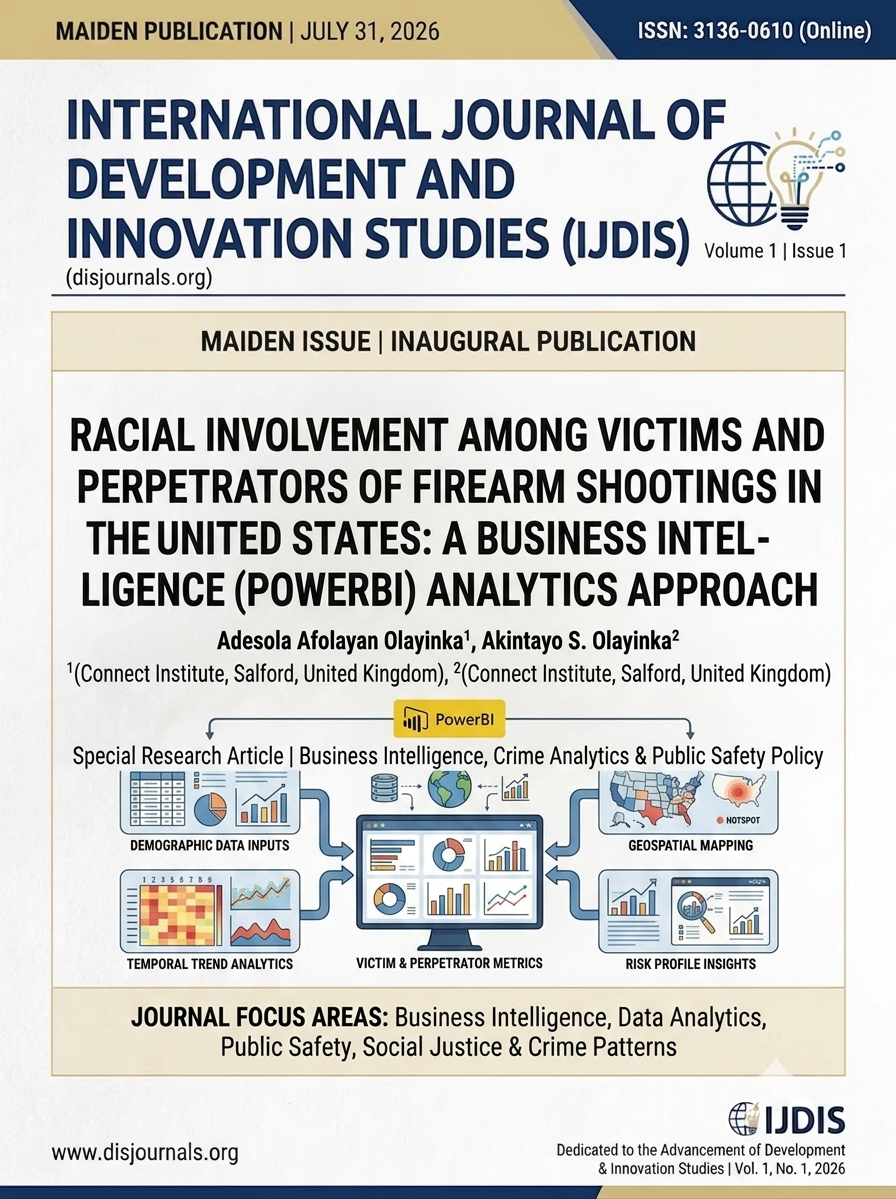
The Racial Involvement among Victims and Perpetrators of Firearm Shootings in the United States: A Business Intelligence (Power BI) Analytics Approach
DOI:
https://doi.org/10.67221/vn3a9y89Keywords:
firearm violence, racial disparities, victims, perpetrators, Power BI, Critical Race Theory, structural violence, United States, 2021Abstract
Firearm violence remains a major public health and peacebuilding concern in the United States. Using incident data from the U.S. Government open data portal (data.gov) and national mortality statistics, this study applies an extract–transform–load workflow and interactive dashboards in Microsoft Power BI to describe racial patterns among victims and alleged perpetrators in 2021. Descriptive analytics indicate concentration of both victimisation and perpetration among Black populations in the incident-level dataset, while Asian Pacific Islander and Icelandic categories are the least represented. Perpetrator involvement peaks in the 25–44 age band, followed by 18–24. Interpreted through Critical Race Theory and peace and conflict lenses, the observed patterns are discussed as products of historically structured inequality, spatial segregation, and differential exposure to risk, rather than as products of demographic essentialism. The study illustrates the value of transparent dashboards for evidence-informed policy while noting limits in population adjustment and victim–perpetrator linkage within public datasets.
References
REFERENCES
[1] Centers for Disease Control and Prevention, National Center for Health Statistics, “Deaths: Final data for 2021,” National Vital Statistics
Reports, vol. 73, no. 8, Oct. 4, 2024. Available: https://www.cdc.gov/nchs/data/nvsr/nvsr73/nvsr73-08.pdf
[2] Pew Research Center, “What the data says about gun deaths in the U.S.,” Mar. 5, 2025. Available: https://www.pewresearch.org/short
reads/2025/03/05/what-the-data-says-about-gun-deaths-in-the-us/
[3] Johns Hopkins Bloomberg School of Public Health, Center for Gun Violence Solutions, “U.S. gun violence in 2021: A year in review,”
Jan. 2024. Available: https://publichealth.jhu.edu/sites/default/files/2024-01/2023-june-cgvs-u-s-gun-violence-in-2021-v3.pdf
[4] J. Peterson, J. Erickson, and K. Knapp, “Communication of intent to do harm preceding mass public shootings in the United States, 1966
to 2019,” JAMA Network Open, 2022.
[5] Gun Violence Archive, “Mass shootings,” 2023. Available: https://www.gunviolencearchive.org/
[6] J. Densley and J. Peterson, “A Multi-Level, Multi-Method Investigation of the Psycho-Social Life Histories of Mass Shooters,” 2021.
[7] D. Attenborough (Dir.), Gandhi, motion picture, 1982.
[8] X. Xie et al., “The impacts of climate change on violent conflict risk,” Environmental Research Letters, 2024.
[9] T. L. Armstead et al., “Structural and social determinants of inequities in violence risk,” International Journal of Environmental Research
and Public Health, 2019.
[10] R. Martin et al., “Racial disparities in children’s exposure to firearm violence,” Journal of Adolescent Health, vol. 70, no. 6, pp. 102
110, 2022. doi: 10.1016/j.jadohealth.2022.01.003.
[11] C. A. Rees et al., “Trends and disparities in firearm fatalities in the United States,” JAMA Network Open, vol. 5, no. 5, e2217128,
2022. doi: 10.1001/jamanetworkopen. 2022.17128.
[12] R. Smart et al., “Racial and ethnic differences in the effects of state firearm laws,” Injury Epidemiology, vol. 10, no. 1, 2023. doi:
10.1186/s40621-023-00477-y.
[13] J. A. Ward et al., “Differences in perceptions of gun-related safety by race and gun ownership: Findings from the U.S.,” Frontiers in
Public Health, vol. 11, 2023. doi: 10.3389/fpubh.2023.10209993.
[14] Brady Campaign to Prevent Gun Violence, “Gun violence is a racial justice issue,” n.d. Available:
https://www.bradyunited.org/resources/issues/gun-violence-is-a-racial-justice-issue
[15] M. Weerdesteijn, “Democracies, Dictatorial Regimes, and Atrocities,” 2024.
[16] M. A. Bellis et al., “The Commercial Determinants of Violence: Identifying commercial drivers of violence and opportunities for
prevention,” International Journal of Environmental Research and Public Health, 2024.
[17] A. Meleagrou-Hitchens, A. Alexander, and N. Kaderbhai, “Literature review: The impact of digital communications technology on
violent extremism,” International Affairs, 2017.
[18] Federal Bureau of Investigation, “Active Shooter Incidents in the United States in 2021,” 2022.
[19] Rockefeller Institute of Government and State University of New York, policy brief on mass shooting incidents and perpetrator
demographics, 2018.
[20] Data.gov, “Open Data from the U.S. Government,” accessed Feb. 2026. Available: https://www.data.gov/
[21] A. A. Olayinka et al., preprint, 2023. doi: 10.22541/au.169609849.93680515/v2
Published
Issue
Section
License
Copyright (c) 2026 Adesola A. Olayinka, Akintayo S. Olayinka (Author)

This work is licensed under a Creative Commons Attribution 4.0 International License.
Open Access Licensing Policy
International Journal of Development and Innovation Studies (IJDIS)
Published by DisJournals.org
IJDIS is an open-access journal committed to the free dissemination of scholarly knowledge.
All articles published in IJDIS are licensed under:
Creative Commons Attribution 4.0 International Licence (CC BY 4.0)
Under the CC BY 4.0 licence, readers are permitted to:
- share — copy and redistribute the material in any medium or format;
- adapt — remix, transform, and build upon the material for any purpose, including commercial purposes;
provided that appropriate credit is given to:
- the original author(s);
- the article title;
- IJDIS as the original publication source;
- the DOI link of the published article.
The licence requires users to provide appropriate attribution and indicate if changes were made.
The CC BY 4.0 licence supports maximum visibility, accessibility, and reuse of research outputs while protecting authors' intellectual contributions.
Full licence information is available at: