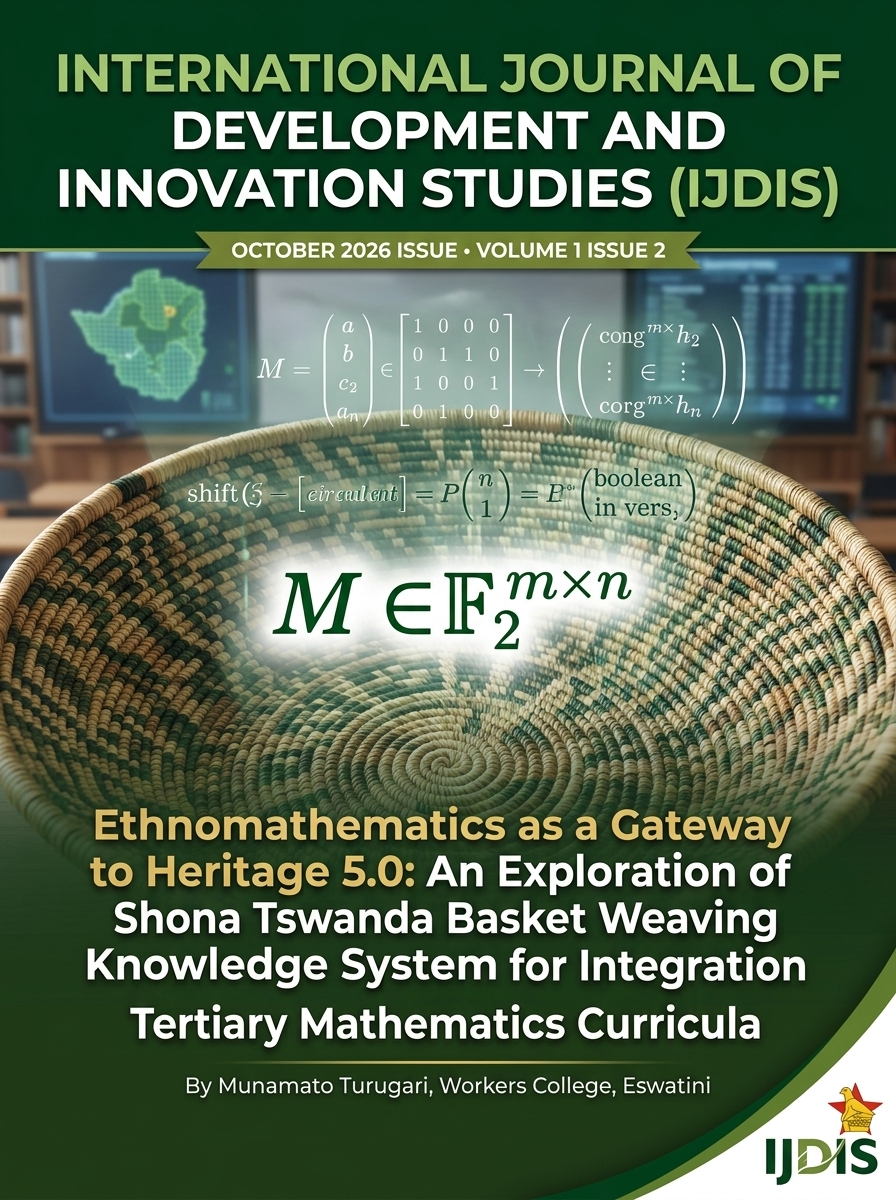
Ethnomathematics as a Gateway to Heritage 5.0: An Exploration of Shona Tswanda Basket Weaving Knowledge System for Integration into Tertiary Mathematics Curricula
DOI:
https://doi.org/10.67221/1880jc83Keywords:
Heritage 5.0, IKS, Ethnomathematics, Tswanda, Tertiary Mathematics CurriculumAbstract
This study explores mathematical concepts embedded in Shona tswanda basket weaving for potential integration into tertiary mathematics, in line with Zimbabwe's Education 5.0 and Heritage 5.0. Despite this policy, mathematics instruction remains Eurocentric. Using a qualitative ethnomathematical design, data were collected from 6 weavers through fieldwork and interviews. A two-round Delphi with 8 experts validated the relevance and cultural authenticity of the identified concepts. Findings show tswanda weaving embodies binary matrices M ∈
References
REFERENCES
Ascher, M. (2002). Ethnomathematics: A multicultural view of mathematical ideas. Chapman and Hall/CRC. https://doi.org/10.1201/9780203743324
Banda, C., & Morgan, L. (2023). Contextualized mathematics instruction in African universities. Journal of Decolonizing STEM, 8(2), 112–129.
Biggs, J. (2003). Aligning teaching for constructing learning. Higher Education Academy, 1(4), 1–12. https://www.researchgate.net/publication/255583992_Aligning_Teaching_for_Constructing_Learning
Bishop, A. J. (1988). Mathematical enculturation: A cultural perspective on mathematics education. Kluwer Academic Publishers. https://doi.org/10.1007/978-94-009-2657-8
Chikomba, A., & Mavhunga, E. (2021). Operationalizing Education 5.0 in Zimbabwean higher education: Opportunities and challenges. Zimbabwean Journal of Educational Research, 33(1), 45–67.
D'Ambrosio, U. (1985). Ethnomathematics and its place in the history and pedagogy of mathematics. For the Learning of Mathematics, 5(1), 44–48. https://www.jstor.org/stable/40247876
Dias, R. (2022). Algebraic structures in traditional arts and crafts. International Journal of Mathematical Education, 41(1), 45–62.
Eglash, R. (1999). African fractals: Modern computing and indigenous design. Rutgers University Press.
Francois, K. (2010). The ethno-mathematical movement: Educational perspectives and political challenges. Journal of Mathematics and Culture, 5(1), 1–15.
Freire, P. (1970). Pedagogy of the oppressed. Continuum.
Gerdes, P. (1999). Geometry from Africa: Mathematical and educational explorations. Mathematical Association of America.
Kincheloe, J. L. (2008). Knowledge and critical constructivism: Jumpstarting historical consciousness. Peter Lang.
Kumar, S. (2021). Ethno-mathematical practices in non-Western cultures: Bridging craft and academic logic. Ethno-mathematics Research Journal, 14(3), 88–104.
Ladson-Billings, G. (1995). Toward a critical race theory of education. Teachers College Record, 97(1), 47–68. https://doi.org/10.1177/016146819509700104
Lakoff, G., & Núñez, R. E. (2000). Where mathematics comes from: How the embodied mind brings mathematics into being. Basic Books.
Lave, J., & Wenger, E. (1991). Situated learning: Legitimate peripheral participation. Cambridge University Press. https://doi.org/10.1017/CBO9780511815355
Mabotja, M. (2020). Integrating indigenous knowledge systems into higher education STEM curricula. African Journal of Educational Decolonization, 11(1), 33–50.
Ministry of Higher and Tertiary Education, Innovation, Science and Technology Development. (2019). Education 5.0 policy document. Government of Zimbabwe. https://www.mhtestd.gov.zw/
Mukhopadhyay, S., & Greer, B. (2012). Cultural development of mathematical ideas and pedagogical implications. In A. J. Bishop, M. A. Clements, C. Keitel, J. Kilpatrick, & F. K. S. Leung (Eds.), Third International Handbook of Mathematics Education (pp. 865–892). Springer. https://doi.org/10.1007/978-1-4614-4684-2_27
Rosa, M., & Orey, D. C. (2016). Current state of research on ethnomathematics in the ICME-13 topical survey. Springer. https://doi.org/10.1007/978-3-319-30120-4
Shulman, L. S. (1986). Those who understand: Knowledge growth in teaching. Educational Researcher, 15(2), 4–14. https://doi.org/10.3102/0013189X015002004
Siyepu, S. (2013). Analysis of quantum learning techniques in higher education mathematics. South African Journal of Higher Education, 27(2), 442–460.
Tarugarira, D. (2024). Heritage-based education in Zimbabwean universities: Policy and practice under Education 5.0. Zimbabwean Journal of Higher Education, 19(2), 77–95.
Vithal, R., & Skovsmose, O. (1997). The end of innocence: A critique of ethnomathematics. Educational Studies in Mathematics, 34(2), 131–157. https://doi.org/10.1023/A:1002971922833
Vygotsky, L. S. (1978). Mind in society: The development of higher psychological processes. Harvard University Press.
Zaslavsky, C. (1973). Africa counts: Number and pattern in African cultures. Lawrence Hill Books.
ZIMCHE. (2019). Higher Education Qualification Framework and Accreditation Standards. Zimbabwe Council for Higher Education.
Published
Issue
Section
License
Copyright (c) 2026 Munamato Turugari (Author)

This work is licensed under a Creative Commons Attribution 4.0 International License.
Open Access Licensing Policy
International Journal of Development and Innovation Studies (IJDIS)
Published by DisJournals.org
IJDIS is an open-access journal committed to the free dissemination of scholarly knowledge.
All articles published in IJDIS are licensed under:
Creative Commons Attribution 4.0 International Licence (CC BY 4.0)
Under the CC BY 4.0 licence, readers are permitted to:
- share — copy and redistribute the material in any medium or format;
- adapt — remix, transform, and build upon the material for any purpose, including commercial purposes;
provided that appropriate credit is given to:
- the original author(s);
- the article title;
- IJDIS as the original publication source;
- the DOI link of the published article.
The licence requires users to provide appropriate attribution and indicate if changes were made.
The CC BY 4.0 licence supports maximum visibility, accessibility, and reuse of research outputs while protecting authors' intellectual contributions.
Full licence information is available at: