Environmental, Social and Governance (ESG) Disclosure in Africa: Current State of Play
DOI:
https://doi.org/10.67221/xrfrtd47Keywords:
ESG Disclosure, , Sustainability Reporting, ISSB, IFRS S1/S2, Corporate Governance, African Capital MarketsAbstract
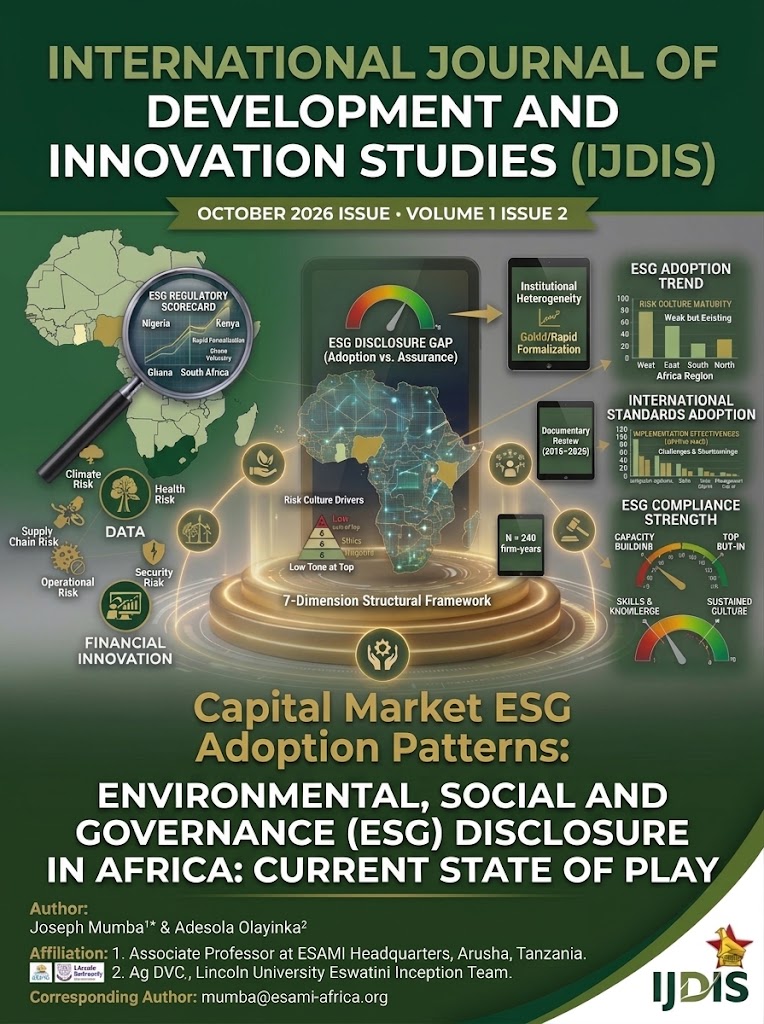
ABSTRACTPurpose: This paper evaluates the operational landscape, regulatory architectures, and corporate adoption patterns of Environmental, Social, and Governance (ESG) disclosures across four key African capital markets: South Africa, Nigeria, Ghana, and Kenya.
Design/methodology/approach: Utilizing a multi-jurisdictional documentary review protocol across the period 2018–2025, regulatory instruments, listing requirements, national accounting codes, and corporate sustainability reports (N = 240 corporate firm-years) were evaluated against a 7-dimension structural framework.
Findings: The results demonstrate significant institutional heterogeneity. South Africa exhibits a mature statutory regime anchored by King IV and mandatory JSE listing rules. Nigeria and Kenya are undergoing rapid regulatory formalization driven by Central Bank mandates and stock exchange sustainability principles, while Ghana maintains a predominantly voluntary framework. Across all markets, a substantial implementation gap persists between regulatory adoption and third-party assurance.
Originality/value: The study provides an empirical diagnostic matrix for capital market regulators and establishes a baseline for tracking the implementation of IFRS S1 and IFRS S2 standards across emerging African economies.
References
1. Adams, C. A., & Abhayawansa, S. (2022). Connecting the COVID-19 pandemic, environmental, social and governance (ESG) investing and accounting. Accounting, Auditing & Accountability Journal, 35(2), 499–516.
2. DiMaggio, P. J., & Powell, W. W. (1983). The iron cage revisited: Institutional isomorphism and collective rationality in organizational fields. American Sociological Review, 48(2), 147–160.
3. Eccles, R. G., Krzus, M. P., & Solano, C. (2019). A survey of integrated reporting in South Africa. Journal of Applied Corporate Finance, 31(2), 22–35.
4. Financial Reporting Council of Nigeria (FRCN). (2024). Roadmap report for the adoption of IFRS Sustainability Disclosure Standards in Nigeria. FRCN Publications, Lagos.
5. Makiwane, P., & Padia, N. (2021). Evaluation of corporate social responsibility disclosure practices in developing countries: Evidence from South Africa. Journal of Accounting in Emerging Economies, 11(4), 540–562.
6. Nelson, M., Okpala, C., & Boateng, A. (2023). Determinants of ESG disclosure quality in Sub-Saharan African banking sectors. International Journal of Disclosure and Governance, 20(3), 285–301.
7. Okaro, S. C., & Okafor, G. O. (2022). Sustainable banking principles and corporate disclosure in West Africa. African Development Review, 34(1), 112–126.
Appendix 1. Global ESG Development Timeline
YEAR KEY ESG DEVELOPMENT
1987 Brundtland Report proposed the concept of Sustainable Development
1990 First ESG Index: Domini Social Index
1997 Global Reporting Initiative(GRI)established
1999 The first GRI Sustainability Reporting Guidelines published
2000 Carbon Disclosure Project(CDP)established
2004 UN Global Compact(UNGC)published Who Cares Wins
2006 UN Principles for Responsible Investment(UN PRI)established
2007 CDP establishes Climate Disclosure Standards Board(CDSB)
2011 Sustainability Accounting Standards Board(SASB)established
2013 International Integrated Reporting Committee(IIRC)proposed Intergrated Reporting Framework(IRF)
2015 UN Sustainable Development Goals (UN SDG) proposed,Task Force on Climate-Related Financial Disclosure(TCFD)established,Paris Agreement signed
2029 EU Taxonomy for Sustainable Activities
2021 IIRC and SASB merged to Value Reporting Foundation(VRF)
2021 Sustainable Finance Disclosure Regulation(SFDR)announced,International Sustainability Standards Board(ISSB)established
2023 ISSB released IFRS S1 and IFRS S2
Published
Issue
Section
License
Copyright (c) 2026 Joseph Mumba , Adesola A Olayinka (Author)

This work is licensed under a Creative Commons Attribution 4.0 International License.
Open Access Licensing Policy
International Journal of Development and Innovation Studies (IJDIS)
Published by DisJournals.org
IJDIS is an open-access journal committed to the free dissemination of scholarly knowledge.
All articles published in IJDIS are licensed under:
Creative Commons Attribution 4.0 International Licence (CC BY 4.0)
Under the CC BY 4.0 licence, readers are permitted to:
- share — copy and redistribute the material in any medium or format;
- adapt — remix, transform, and build upon the material for any purpose, including commercial purposes;
provided that appropriate credit is given to:
- the original author(s);
- the article title;
- IJDIS as the original publication source;
- the DOI link of the published article.
The licence requires users to provide appropriate attribution and indicate if changes were made.
The CC BY 4.0 licence supports maximum visibility, accessibility, and reuse of research outputs while protecting authors' intellectual contributions.
Full licence information is available at: